
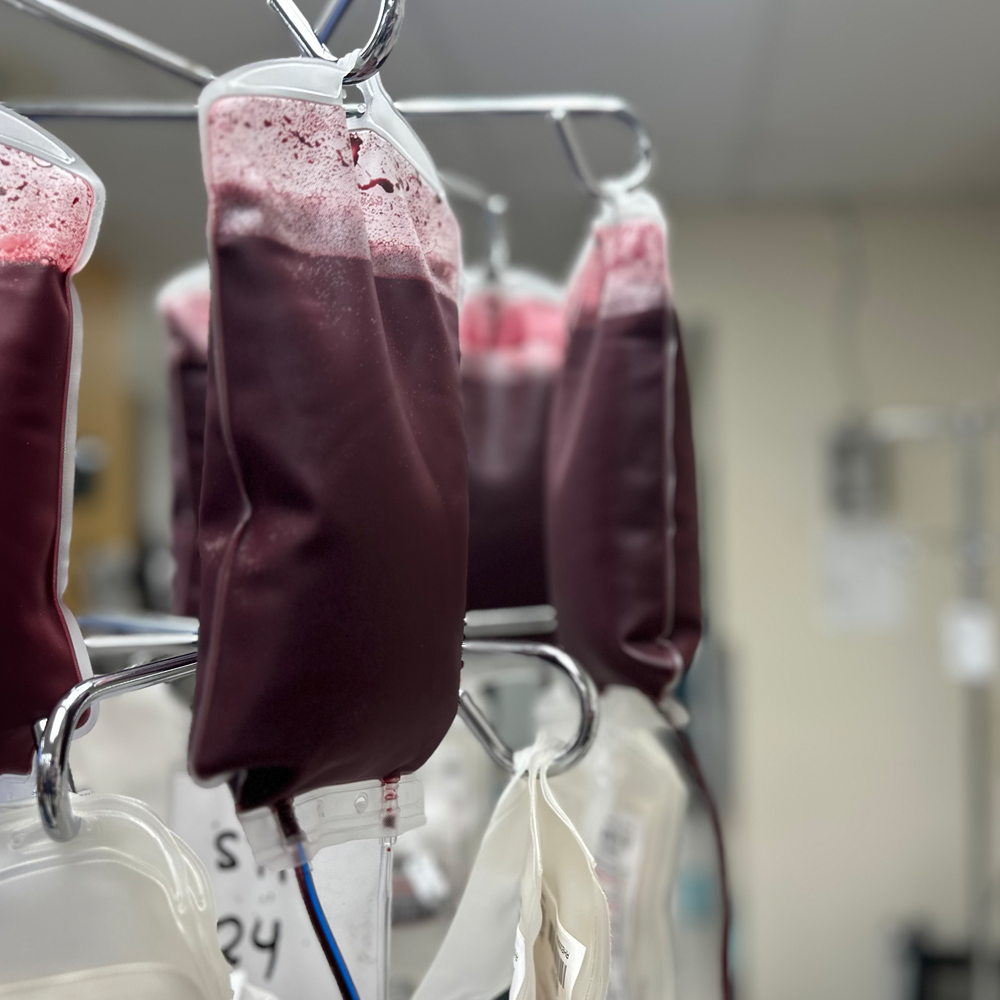
Prehospital blood transfusion (PHBT) was recently reviewed in the 2024 military supplement of the Journal of Trauma and Acute Care Surgery.1 The authors noted that the practice of blood product administration before a patient arrives at a medical facility originated in the battlefield. In many cases, military medics were able to prevent immediate death from hemorrhagic shock. There are no national databases relating civilian PHBT to hospital outcomes, but studies supporting military and civilian use were cited.
Civilian interfacility transports began administering blood products in the 1980s. However, blood products–specifically, red blood cells (RBCs) and liquid plasma–were not placed on ground ambulances until 2016. Blood product use was impeded by the complexity of giving multiple products, such as the aforementioned RBCs and plasma, or RBCs with plasma and platelets in a 1:1:1 ratio. In response,2 since April 2018,3 AABB Standards for Blood Banks and Transfusion Services have allowed low-titer group O whole blood for a recipient whose ABO group is unknown,4 as is typical in PHBT. As a result, low-titer group O Rh(D)-positive whole blood is available to 66% of 9-1-1 ground emergency medical services (EMS) agencies, and low-titer group O Rh(D)-negative whole blood is available to another 6%. Other products available to some agencies are RBCs and liquid plasma. About 60% of agencies receive products directly from a blood supplier. The rest receive products from a hospital or from a blood supplier via a hospital. Whether unused products may be returned and under what conditions they may be returned vary. Forty to sixty percent of prehospital transfusions are for medical and non-trauma hemorrhagic shock, although at least one cited study acknowledged the lack of data supporting its efficacy.5
Despite the data supporting PHBT and a major blood banking standards organization’s permission for transfusion of low-titer group O whole blood, less than 1% of EMS agencies in the US had implemented PHBT as of October 2023. Several major obstacles to PHBT were discussed.
- State scope of practice limitations. The National EMS Scope of Practice Model defines EMS personnel levels and permits personnel at the paramedic level to “[m]aintain infusion of blood or blood products.”6 The requirement in many states that a registered nurse or physician be present when transfusion is started is thus allowed by the model. Furthermore, implementation of the model is not mandatory, and each state defines the scope of practice for each level of EMS personnel.
- Program costs and reimbursement of blood products. Medicare payment rates and those of private healthcare insurers are insufficient to cover PHBT costs. Several large blood banking organizations, including the American Red Cross, feel that recently proposed updates to Medicare fail to correct this problem.7
- Lack of data on prehospital hemorrhagic shock management and associated patient outcomes. Data on hemorrhagic shock and patient outcomes would support PHBT improvement. However, there are no regional, state, or national systems for collection of these data. Midsize and smaller EMS agencies lack staff for data collection. Hospital reporting of patient outcomes to EMS agencies is inconsistent. Trauma centers are concerned that incorporation of EMS agency data into their trauma registries may violate the Health Insurance Portability and Accountability Act of 1996 (HIPAA). Many patients receive care at non-trauma-designated hospitals that do not have registries. Finally, there are no accepted methods for collecting data on nontraumatic hemorrhage, which accounts for a large proportion of PHBT, as previously noted.
Addressing these challenges will require collaboration among EMS agencies, blood suppliers, hospital clinicians, and transfusion services. The Prehospital Blood Transfusion Initiative Coalition is a national collaborative that includes these stakeholders, among them the Red Cross, and others.8
In situations in which PHBT programs are not feasible, the authors argue for the development of low-cost, shelf-stable products such as artificial RBC substitutes and dried plasma. They also briefly address providing blood products during disasters, suggesting, for example, donor prescreening and the use of untested fresh whole blood.
The authors have summarized the state of a developing area of blood banking and transfusion medicine and strongly encourage action, contending that eliminating barriers to PHBT will save lives threatened by prehospital hemorrhage.
References
1. Schaefer RM, Bank EA, Krohmer JR, Haskell A, Taylor AL, Jenkins DH, Holcomb JB. Removing the barriers to prehospital blood: A roadmap to success. J Trauma Acute Care Surg. 2024;97(2S Suppl 1):S138-S144. https://doi.org/10.1097/TA.0000000000004378.
2. Response to Comments Received to the 31st edition of Standards for Blood Banks and Transfusion Services [Internet]. Bethesda: AABB – Association for the Advancement of Blood & Biotherapies [cited 2024 Sep 22]. Available from: https://www.aabb.org/docs/default-source/default-document-library/standards/response-to-comments-standards-for-blood-banks-and-transfusion-services-31st-edition.pdf?sfvrsn=acbb17a7_0.
3. Schweitzer J. Hot topic changes to the 31st edition of Standards for Blood Banks and Transfusion Services. AABB News 2018;20(7):16-7. https://www.aabb.org/docs/default-source/member-protected-files/news/aabb-news-magazine/news1807.pdf?sfvrsn=7749690d_8.
4. Standards for Blood Banks and Transfusion Services [Internet]. 34th ed. Bethesda: AABB – Association for the Advancement of Blood & Biotherapies. Standard 5.27.1 [cited 2024 Sep 22]. Available from: http://standards.aabb.org/pages/external/standard.aspx?catalogId=275.
5. Smith AA, Alkhateb R, Braverman M, Shahan CP, Axtman B, Nicholson S, Greebon L, Eastridge B, Jonas RB, Stewart R, Schaefer R, Foster M, Jenkins D. Efficacy and safety of whole blood transfusion in non-trauma patients. Am Surg. 2023;89:4934-6. https://doi.org/10.1177/00031348211048831.
6. National Association of State EMS Officials. National EMS scope of practice model 2019: including change notices 1.0 and 2.00 (Report No. DOT HS 813 151). National Highway Traffic Safety Administration. Chapter VI, Interpretive guidelines; [cited 2024 Sep 22]; p. 29. Available from: https://www.ems.gov/assets/National_EMS_Scope_of_Practice_Model_2019_Change_Notices_August_2021.pdf.
7. Ben-Avram D, Fry K, Hrouda JC. RE: Medicare and Medicaid Programs; CY 2025 Payment Policies Under the Physician Fee Schedule and Other Changes to Part B Payment and Coverage Policies; Medicare Shared Savings Program Requirements; Medicare Prescription Drug Inflation Rebate Program; and Medicare Overpayments [Internet]. 2024 Sep 3 [cited 2024 Sep 22]. Available from: https://www.aabb.org/docs/default-source/default-document-library/positions/joint-comments-to-cms-on-the-cy25-physician-fee-schedule-proposed-rule-on-the-ambulance-fee-schedule.pdf?sfvrsn=9c9904f6_3.
8. Prehospital Blood Transfusion Initiative Coalition [Internet]. [place unknown]; [cited 2024 Sep 22]. Available from: https://prehospitaltransfusion.org.
