
The patient blood management movement has improved transfusion care while reducing the total use of red blood cell (RBC) units. Data from the National Blood Collection and Utilization Surveys reveals that U.S. allogeneic, nondirected RBC unit transfusions have dropped by 30% from 20081 to 2023.2 These changes resulted from several initiatives spearheaded by the AABB, including the recommendation in 2012 to use a restrictive transfusion threshold for stable hospitalized patients3 and the Choosing Wisely campaign in 2014.4
Unfortunately, these decreases were not experienced by some ABO/Rh types, particularly O-negative. The number of allogeneic O-negative RBC units transfused increased from 735,000 (5.4% of all units) in 20115 to 1,344,000 (12.5% of all units) in 2021.6 To keep pace with this growth, O-negative RBCs are consistently collected beyond the abundance of O-negative donors in the U.S. population (about 7%).7 For example, in 2021, 9.8% of distributed RBC units were O-negative.6 As a result, the U.S. O-negative supply is in a state of chronic shortage.8 Data from national and provincial blood centers outside the U.S. have also demonstrated decreasing total RBC distributions but increasing dependence on O-negative.9
Why have we as a transfusion community become more dependent on O-negative? Recent work may shed some light on this question. The GROUP study, a retrospective review of group O RBC usage collected from 38 hospitals in 11 countries in 2013,10 revealed that 43.2% of O-negative RBCs transfused to patients with a known blood type went to non-O-negative patients. 63.2% of hospitals provided O-negative RBCs for all patients in need of uncrossmatched blood. In a study leveraging data from 31 institutions spanning calendar year 2016 (the OPTIMUS study), 43.6% of O-negative RBCs were transfused to known non-O-negative patients.11
The practice of providing O-negative RBCs for any emergency need is deeply ingrained in transfusion history.12 However, in response to O-negative RBC overuse, the AABB recommendations for the Choosing Wisely campaign included reserving these products for O-negative patients and, in an emergency, patients with childbearing potential when the blood type is unknown.4 AABB Association Bulletin #19-02 made a similar recommendation.13 Evidence supports that providing O-positive RBCs to females beyond childbearing potential, commonly regarded as 50 years old or older,10 and adult males with unknown blood type is safe and effective for emergency transfusion. The risk of alloimmunization for Rh-negative patients receiving O-positive RBCs is only about 21-26% for hospitalized patients.14-18 Importantly, when viewed through the lens that the vast majority of patients with unknown blood type will be Rh-positive, the de facto immunization rate is about 3-6% for all patients transfused.19 The process of primary RhD alloimmunization takes a month or longer,20 by which time the residual Rh-positive red cells still in circulation are greatly reduced.21 The clearance of the remaining Rh-positive cells occurs via low-grade, extravascular hemolysis22 and characteristically without symptoms.23
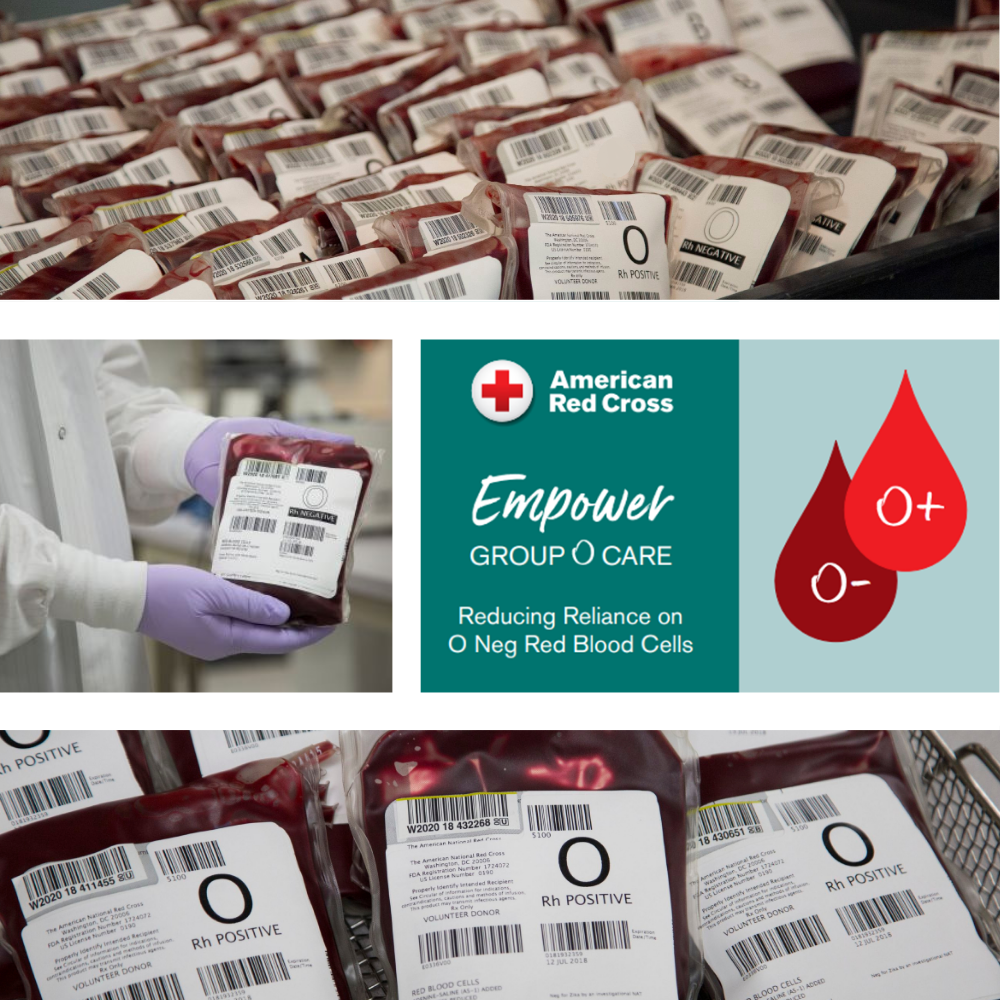
In February 2025, the American Red Cross launched the Empower Group O initiative. The key tenets of this campaign are to Start Smart and Switch Sooner. In accordance with the AABB Association Bulletin, the Red Cross is leading the charge with our hospital partners to reduce O-negative utilization nationwide. We are helping our hospital partners to Start Smart, starting emergency transfusion for patients with unknown blood type with O-positive RBCs. The sole exception to this strategy would be patients with childbearing potential. Transfusion services should also Switch Sooner—i.e., have policies for (1) switching from O-negative RBCs to O-positive to avoid depleting the O-negative supply and (2) switching to type-specific RBCs as soon as possible. For example, many institutions will consider switching patients to O-positive RBCs after issuing the first round of a massive transfusion protocol (e.g., 6 initial O-negative RBC units). To support these practices, the American Red Cross can provide example SOPs from institutions that have shared their protocols.
These changes will free up O-negative RBCs for those who need them most, O-negative patients and those of unknown blood type with childbearing potential. Hospitals supplied by the Red Cross are encouraged to access the SUCCESS talk on this subject (https://arcbiomed.my.site.com/s/login/) and consult their Red Cross regional medical director about updating their SOPs. Together, we will empower our group O-negative blood to save lives where it is needed most.
References
1. Whitaker B, Schlumpf K, Schulman J, Green J. The 2009 National Blood Collection and Utilization Survey report. [Washington]: US Department of Health and Human Services; 2011. Report No.: ISBN 978-1-56395-328-6.
2. Kracalik I. 2023 National Blood Collection and Utilization Survey. Paper presented at: 2024 AABB Annual Meeting; 2024 Oct 19-22; Houston, TX.
3. Carson JL, Grossman BJ, Kleinman S, Tinmouth AT, Marques MB, Fung MK, Holcomb JB, Illoh O, Kaplan LJ, Katz LM, Rao SV, Roback JD, Shander A, Tobian AA, Weinstein R, Swinton McLaughlin LG, Djulbegovic B; Clinical Transfusion Medicine Committee of the AABB. Red blood cell transfusion: a clinical practice guideline from the AABB*. Ann Intern Med 2012;157:49-58.
4. Callum JL, Waters JH, Shaz BH, Sloan SR, Murphy MF. The AABB recommendations for the Choosing Wisely campaign of the American Board of Internal Medicine. Transfusion 2014;54:2344-52.
5. Whitaker B, Hinkins S. The 2011 national blood collection and utilization survey. [Washington]: US Department of Health and Human Services; 2013.
6. Kracalik I, Sapiano MRP, Wild RC, Chavez Ortiz J, Stewart P, Berger JJ, Basavaraju SV, Free RJ. Supplemental findings of the 2021 National Blood Collection and Utilization Survey. Transfusion 2023;63 Suppl 4:S19-S42.
7. Garratty G, Glynn SA, McEntire R; Retrovirus Epidemiology Donor Study. ABO and Rh(D) phenotype frequencies of different racial/ethnic groups in the United States. Transfusion 2004;44:703-6.
8. Weekly blood supply report [Internet]. Association for the Advancement of Blood & Biotherapies [cited 2025 Feb 26]. Available from: https://www.aabb.org/for-donors-patients/weekly-blood-supply-report.
9. Yazer MH, Jackson B, Beckman N, Chesneau S, Bowler P, Delaney M, Devine D, Field S, Germain M, Murphy MF, Sayers M, Shaz B, Shinar E, Takanashi M, Vassallo R, Wickenden C, Yahalom V, Land K; Biomedical Excellence for Safer Transfusions (BEST) Collaborative. Changes in blood center red blood cell distributions in the era of patient blood management: the trends for collection (TFC) study. Transfusion 2016;56:1965-73.
10. Zeller MP, Barty R, Aandahl A, Apelseth TO, Callum J, Dunbar NM, Elahie A, Garritsen H, Hancock H, Kutner JM, Manukian B, Mizuta S, Okuda M, Pagano MB, Pogłód R, Rushford K, Selleng K, Sørensen CH, Sprogøe U, Staves J, Weiland T, Wendel S, Wood EM, van de Watering L, van Wordragen-Vlaswinkel M, Ziman A, Jan Zwaginga J, Murphy MF, Heddle NM, Yazer MH; Biomedical Excellence for Safer Transfusion (BEST) Collaborative. An international investigation into O red blood cell unit administration in hospitals: the GRoup O Utilization Patterns (GROUP) study. Transfusion 2017;57:2329-2337.
11. Dunbar NM, Yazer MH; OPTIMUS Study Investigators on behalf of the Biomedical Excellence for Safer Transfusion (BEST) Collaborative. O- product transfusion, inventory management, and utilization during shortage: the OPTIMUS study. Transfusion 2018;58:1348-1355.
12. Kruskall MS, Mintz PD, Bergin JJ, Johnston MF, Klein HG, Miller JD, Rutman R, Silberstein L. Transfusion therapy in emergency medicine. Ann Emerg Med 1988;17:327-35.
13. Association Bulletin #19-02 [Internet]. Association for the Advancement of Blood & Biotherapies [cited 2025 Feb 26]. Available from: https://www.aabb.org/docs/default-source/default-document-library/resources/association-bulletins/ab19-02.pdf.
14. Dutton RP, Shih D, Edelman BB, Hess J, Scalea TM. Safety of uncrossmatched type-O red cells for resuscitation from hemorrhagic shock. J Trauma 2005;59:1445-9.
15. Meyer E, Uhl L. A case for stocking O D+ red blood cells in emergency room trauma bays. Transfusion 2015;55:791-5.
16. Flommersfeld S, Mand C, Kühne CA, Bein G, Ruchholtz S, Sachs UJ. Unmatched Type O RhD+ Red Blood Cells in Multiple Injured Patients. Transfus Med Hemother 2018;45:158-161.
17. Frohn C, Dümbgen L, Brand JM, Görg S, Luhm J, Kirchner H. Probability of anti-D development in D- patients receiving D+ RBCs. Transfusion 2003;43:893-8.
18. Yazer MH, Triulzi DJ. Detection of anti-D in D- recipients transfused with D+ red blood cells. Transfusion 2007;47:2197-201.
19. Selleng K, Jenichen G, Denker K, Selleng S, Müllejans B, Greinacher A. Emergency transfusion of patients with unknown blood type with blood group O Rhesus D positive red blood cell concentrates: a prospective, single-centre, observational study. Lancet Haematol 2017;4:e218-e224.
20. Lozano M, Cid J. The clinical implications of platelet transfusions associated with ABO or Rh(D) incompatibility. Transfus Med Rev 2003;17:57-68.
21. Ebaugh FG Jr, Emerson CP, Ross JF. The use of radioactive chromium 51 as an erythrocyte tagging agent for the determination or red cell survival in vivo. J Clin Invest 1953;32:1260-76.
22. Hughes Jones NC, Mollison PL, Veall N. Removal of incompatible red cells by the spleen. Br J Haematol 1957;3:125-33.
23. Pollack W, Ascari WQ, Crispen JF, O’Connor RR, Ho TY. Studies on Rh prophylaxis. II. Rh immune prophylaxis after transfusion with Rh-positive blood. Transfusion 1971;11:340-4.
